

Creating a myth…
Like most things left liberal, there is a glorification campaign to resurrect a 1976 movie and declare it a classic. And, like most things left liberal, this is about creating a false icon. Spinning a narrative out of someone else’ achievement, barking up the wrong tree and pursuing political agenda in the guise of art. That the film was quite dumbly praised by Dhruv Rathee in one of his trademark videos and recommended to his audience, was enough to arouse a suspicion and look more closely at what could be the game plan here.
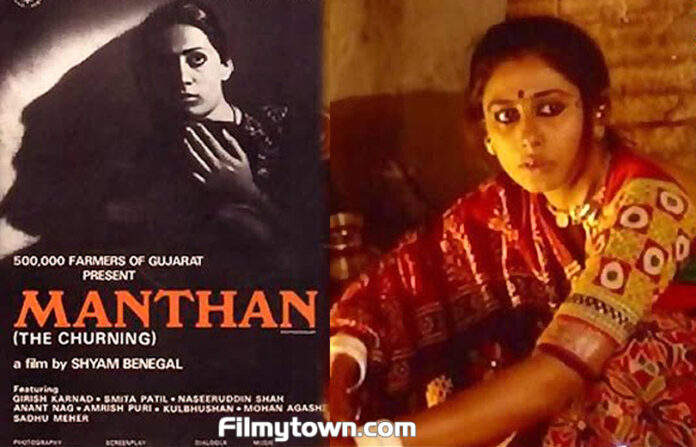
The movie is Shyam Benegal’s ‘Manthan’ which was made in 1976. The film was screened at Cannes film festival this year as it’s reintroduction to the global audiences in the ‘Classic’ segment. Rich tributes were paid to the film, which as we shall see, were quite disproportionate to its merit.
What’s the myth here? Well, there are many. The film about the white revolution is in fact a bundle of white lies. If Manthan was at best a well-made lie in 1976, looks like it’s now a tool for full blown propaganda. Let’s start from the beginning.
What’s the yard stick to judge?
First, a simple check on where it stands on filmmaking quality, with respect to the industry standards. Manthan, when it was made, could at best have been considered a mediocre movie. As a comparison, Anand, Mughal-e-Azam, Mother India and Sholay had been made much before Manthan and were overwhelmingly superior in terms of emotional appeal, production grandeur, social commentary and drama quotient – respectively. By today’s standard it will be a pedestrian film, even after adjusting for the technology difference of the era.
How to spin a sales gimmick…
The film starts with what looks like a clever lie – that it was crowd funded by 5,00,000 farmers of Gujrat. The truth is it was corporate funded. The Gujrat Cooperative Milk Marketing Federation (GCMMF), the body that controlled the milk business across the state of Gujrat, paid Rs 2 less to all their farmer suppliers – who were around 5 lakhs in number – for 1 day and funded the film from the Rs 10 lakhs thus saved. If Reliance Industries today charges Re1 excess for each of it’s Gio subscriber, chances are most people will not notice. If they then and fund a film by Rs 10Cr, will anyone call it crowd funding? The same liberals will declare it a publicity stunt and will start the familiar Ambani bashing. How was it different for GCMMF?
Can we set ‘Gone with the wind’ in the 70s?
The film is made in 1976 and is also set in the same period – made clear by several references such as costumes, gadgets, and contemporary events such as film songs playing on radio. The fact is the milk cooperative movement in Gujrat started in the 1940s, more than 30 years before the film was made. It grew through the 50s had matured through the 60s and was declared a success by the 70s. That India’s first two Prime Ministers – Jawaharlal Nehru and Lal Bahadur Shastri – supported the movement and personally visited Anand – means the milk cooperative movement had visibility up to the highest level of country’s leadership and their full support more than a decade before this film was made. After initial successes, the smaller cooperatives were merged to form the GCMMF – a corporate behemoth in farmers clothing – in 1973. By 1976, Amul was already a big brand. So, if showing a milk cooperative in its early days of struggle in the mid 1970s was not a big lie then it was an act of carelessness or incompetence. One does not want to associate any of these attributes to the maker, writer or director of the film, but the facts simply don’t allow the luxury of any other conclusion.
What did they really want to show?
Next, let’s look at the messaging. As explained, by the time this film was made, operation flood was a huge success and in tandem with the green revolution had made India self-sufficient in food production. One would therefore have expected the film to be telling an inspirational success story, even if the inevitable initial struggle was to be recounted. What one gets is a gloomy, overly negative and exaggerated account of the caste system, caste system and more caste system with the milk business just an excuse. It is almost as if the Indian society was totally incapable of grabbing a new opportunity if it came their way. This assumption was proved to be entirely wrong two decades later when the Indian economy was freed from the clutches of the socialist-communist economics. Various business and industry segments, hitherto non existent, not only made a start but were spectacular successes. IT, Telecomm, hospitality, automobiles and healthcare are good examples. Rather than highlighting the mistake of policy makers in strangling the society by not giving them any options of business enterprise, the leftist narrative as usual blames it on the poor desperate population and their Hindu milieu.
While the attempt is to show as if India is nothing other than caste system, the film either gets it wrong on this front as well or has an agenda to show the so-called upper castes in poor light irrespective of what they actually did. In the village, Mishra, obviously a Brahmin is shown as the cunning, exploitative milk trader. Anyone who has been to Indian villages knows that Brahmins – thanks or no thanks to the same caste system – hardly ever ventured into milk business. In fact, the very caste system which the film revolves around, has assigned the milk business to a few castes. These are quite well known across north and central India and are routinely found to be doing the milk business even today.
One member of the team that arrives from the city to set up the milk cooperative, is shown to have indulged in sexual encounters with a local girl, which results in the girl getting pregnant. The man is given a Maharashtrian Brahmin name. After independence, thousands of Brahmins from states like Tamil Nadu, Maharashtra, West Bengal and others took up government jobs in small towns and villages. For sure, they got these jobs due to their caste privilege. But in first 50 years after independence, hardly any instance is reported like what is shown in this film. On the other hand, these educated and well-intentioned people going to villages resulted in invaluable contribution in areas of education, healthcare and public works – as the infrastructure was called in those days. The episode looks very artificial and almost as if inserted as – what in today’s lexicon can be called an ‘item’.
Attention to details – what is that?
Finally, coming to few other aspects of film making such attention to details, development of characters as part of screen play – and the picture is hardly bright. Mishra – as is commonly known – is a name generally found in UP and not likely to be found in Gujrat. To add to it – the Mishra of Manthan quite strangely speaks Hindi with a heavy Punjabi accent. This is quite inexplicable and again has to be attributed to carelessness. Maybe Amrish Puri – the actor who plays Mishra – was asked to improvise and be rural. He did just that in the only way he knew – from his native Punjab. The language of other characters is quite inconsistent – its mostly Hindi with some Gujrati words thrown in.
Initially, many people are shown wearing heavy winter clothing. The part of Gujrat the film covers has never known that kind of cold. Maybe someone wrote it sitting in Delhi?
Girish Karnad – playing Dr Rao – sounds like a communist propaganda agent in about half his scenes. At one point he thunders that people contributing less or more milk as per their ownership of cattle will all be treated as equal. Whatever that meant. His wife is inexplicably grumpy.
Does the film have any positives? Well, a few. It’s shot entirely in a village, and therefore scores high on authenticity of the ambience. Naseeruddin Shah and Smita Patil are excellent in their roles. Costumes are well designed and authentic. Cinematography is good. But as mentioned before, these aspects are not on par with what was being done at the time in the industry.
Why now?
Why then the sudden revival of interest in Manthan? Incidentally, and on an unrelated note, the few surviving members of the Manthan cast travelled to Cannes when it was screened there this year. The travel would easily have cost more than what it took to produce the film. Coming to the revival – there seems to be a lot interest in reinventing the caste system and driving it to the center of the political agenda. If anyone wants to slow down India’s otherwise unstoppable progress, this seems to be one way, maybe the only way, of doing it.
Maybe, taking Manthan back to the international audiences is part of the same agenda. To tell the western audience that India is still the same place – of the poverty, the antique trains, uneducated villagers and of course the caste system.
Janardan Pendharkar
October 2024
Bengaluru.